Welcome
Thank you for your interest in my work and the care I offer. I am a licensed Massage Therapist with specialized training and certification in compassionate massage and therapeutic touch for individuals with special needs, those navigating cancer treatment or remission, and those approaching the end of life in palliative or hospice care.This work is deeply sacred to me. Every session is guided by intention, presence, and respect—offering a gentle pause in a world that can feel overwhelming, uncomfortable, or rushed. Through mindful touch, I create a safe and nurturing space where clients are invited to rest, soften, and reconnect with themselves. In this space, touch becomes a quiet companion—supporting peace, comfort, and a deeper sense of wholeness as each person honors their own unique journey.*****If you’re curious or seeking clarity, the FAQ offers thoughtful answers to the questions clients most often ask about massage and touch therapy in this capacity.Explore ABOUT to learn more about the heart, intention, and philosophy that guides this practice.Visit MEET YOUR THERAPIST to learn more about my background, training, and credentials.
Services
Services are offered by appointment only to ensure thoughtful individualized care. Walk-ins are not available.Physical Location:
Within Clubhouse Salon
1800 W Causeway Blvd Ste. 111
Mandeville, LA 70471In-home Coverage areas:
LA Northshore: Slidell, Pearl River, Lacombe, Mandeville, Covington & Madisonville. LA Southshore: Metairie & Kenner.
Off-site appointments are subject to a travel fee of $20 per service.Gift Certificates: are available and offer a heartfelt way to share comfort, care, and kindness with someone you cherish. Each certificate may be applied toward any service and thoughtfully personalized to honor the recipient’s individual needs and circumstances. Whether offered in support, in celebration, or as a meaningful expression of kindness, a gift certificate becomes an invitation for rest, reconnection, and compassionate touch.For questions, comments, or to book an appointment:
Please call/ text 985-205-9415, email [email protected], or click the CONTACT button below to fill out the form. I will return your call or message as soon as possible, typically within a few hours, and always within 24 hours.
Special Needs
Massage & Touch Therapy
Designed to honor the unique needs of individuals living with neurological conditions, physical disabilities, developmental differences, or chronic illness, massage and therapeutic touch offer a deeply supportive experience that nurtures overall wellbeing and enhances quality of life. Each session is thoughtfully individualized, using adaptive and responsive techniques to meet the client exactly where they are. This approach helps ease muscular tension, support mobility, reduce stress, and promote relaxation and pain relief. Above all, the work provides a gentle, hands-on presence—safe, soothing, and nurturing—to support the mind, body, and spirit with care and dignity.Add on a 15 min. caregiver relief massage to any appointment for only $20 more (please notify upon booking)
45 min $85
60 min $105
75 min $125
90 min $150
2 hr $205
Palliative/ Hospice
Massage & Touch therapy
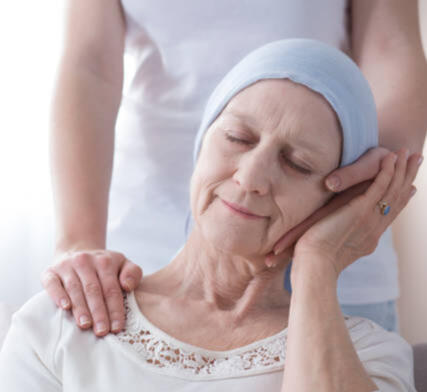
From soft hand placement and gentle lotioning of the skin to light or medium massage strokes, this calming therapy is offered with care, patience, and presence. Each session is designed to support individuals as they navigate the physical, emotional, and mental effects of illness, meeting them exactly where they are in each moment. Thoughtful touch can help ease pain, soften tension, invite rest, and support more peaceful sleep. Just as importantly, it offers comfort to those who may be feeling anxious, fearful, lonely, or overwhelmed—through a soothing presence, mindful hands, and compassionate one-on-one human connection. Within this gentle approach, clients are invited to find a safe place to rest, breathe, and be met with gentleness and support.This service may also include personalized guidance for family members and caregivers who wish to learn safe, nurturing ways to comfort their loved ones through touch.Because of its gentle, adaptive nature, this approach is considered one of the safest forms of massage and touch therapy for individuals receiving palliative or hospice care.Add on a 15 min. caregiver relief massage to any appointment for only $20 more (please notify upon booking)
45 min $85
60 min $105
75 min $125
90 min $150
2 hr $205
Oncology Massage
& Touch Therapy
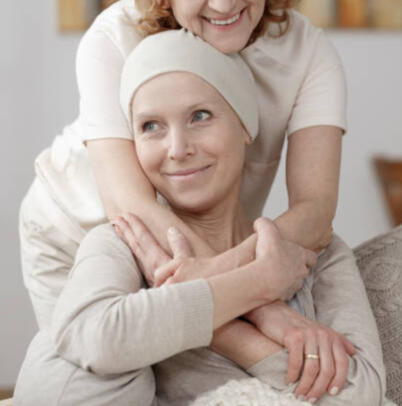
This service is offered to gently support individuals experiencing cancer and the effects of cancer treatment. The intention is to ease discomfort, soften physical and emotional strain, and provide a sense of calm during what can be an overwhelming time.Care is given using soothing lymphatic massage techniques that encourage healthy lymph flow, along with light to medium pressure tailored to each person’s comfort and needs. This gentle approach is widely regarded as one of the safest and most supportive forms of massage therapy for oncology clients, both during treatment and in remission, helping to reduce the risk of developing further complications that may arise from ordinary massage therapy practices, such as Lymphedema.Each session is thoughtfully adapted to honor the individual—considering age, stage of life, treatment plans, and medical history. A detailed medical intake and consultation allow care to be offered with sensitivity, safety, and respect.This approach is considered one of the safest massage therapy options for individuals living with cancer, whether currently in treatment or in remission.Add on a 15 min. caregiver relief massage to any appointment for only $20 more (please notify upon booking)
45 min $85
60 min $105
75 min $125
90 min $150
2 hr $205
Oncology Massage
& Touch Therapy
This service is offered to gently support individuals experiencing cancer and the effects of cancer treatment. The intention is to ease discomfort, soften physical and emotional strain, and provide a sense of calm during what can be an overwhelming time.Care is given using soothing lymphatic massage techniques that encourage healthy lymph flow, along with light to medium pressure tailored to each person’s comfort and needs. This gentle approach is widely regarded as one of the safest and most supportive forms of massage therapy for oncology clients, both during treatment and in remission, helping to reduce the risk of developing further complications that may arise from ordinary massage therapy practices, such as Lymphedema.Each session is thoughtfully adapted to honor the individual—considering age, stage of life, treatment plans, and medical history. A detailed medical intake and consultation allow care to be offered with sensitivity, safety, and respect.This approach is considered one of the safest massage therapy options for individuals living with cancer, whether currently in treatment or in remission.**This service pairs perfectly with Oncology Manual Lymph Drainage.Add on a 15 min. caregiver relief massage to any appointment for only $20 more (please notify upon booking)
45 min $85
60 min $105
75 min $125
90 min $150
2 hr $205
Oncology MLD- Manual
Lymphatic Drainage
Manual Lymph Drainage (MLD) is a gentle, soothing therapy designed to support the natural movement of the lymphatic system—the body’s pathway for fluid balance and waste removal. Using light, rhythmic techniques, MLD encourages lymph fluid to flow more freely and efficiently, helping the body release excess fluid and waste, reduce swelling, support circulation and detoxification, improve metabolism, and boost the immune system to support overall balance and the body’s innate healing processes.For oncology patients who have had lymph nodes removed, there is an increased risk of developing lymphedema—a lifelong condition that requires thoughtful, ongoing care. Regular Manual Lymph Drainage can play an important role in supporting healthy lymph flow and helping to reduce this risk by preventing fluid stagnation within the tissues.MLD can be especially beneficial following surgery, as it gently supports and encourages the healing process. By reducing swelling, fluid retention, and bruising, and by encouraging the removal of cellular waste from affected areas, this therapy may help tissues recover more quickly and comfortably. It can also reduce scar tissue formation and the buildup of fibrotic nodules, improve skin tone and texture, and decreasing the risk of infection by improving the body’s immune response during healing.This service pairs beautifully with Oncology Massage and Touch Therapy, offering an added layer of gentle, restorative support.Add on a 15 min. caregiver relief massage to any appointment for only $20 more (please notify upon booking)
45 min. $110 (site specific)
60 min. $135 (site specific)
75 min. $165 (site specific)
90 min. $185 (full body)
About MK Touch Therapy
This work found me slowly.Over time, through listening—to bodies, to families, to the spaces where words fall away and presence becomes everything. I came to understand that touch, when offered with care and intention, can be a profound source of comfort during life’s most vulnerable seasons.My practice is devoted to providing gentle, specialized massage and touch therapy for those navigating cancer treatment or remission, living with special needs, facing serious illness, or nearing the end of life. I work with people whose bodies require thoughtful adaptation, deep respect, and an approach that honors what is changing—physically, emotionally, and spiritually.While most massage therapy focuses on relaxation or musculoskeletal care, this work lives in a quieter place. It asks for patience, humility, and the ability to meet each person exactly where they are on that day. I chose this path intentionally, knowing that compassionate care for medically complex and tender populations is both uncommon and deeply needed.Specialized Training & ExperienceI have pursued advanced education in oncology massage, palliative and hospice touch therapy, and massage for individuals with special needs—training that goes beyond technique to include safety considerations, medical awareness, emotional sensitivity, and trauma-informed care.This means every session is adapted with care:
• Pressure is adjusted thoughtfully
• Areas of concern are approached with caution and consent
• Energy levels, treatment side effects, and comfort are always respected
• The body’s story is listened to, not overriddenI continue to learn, collaborate, and deepen my understanding, because this work carries responsibility. When someone places their trust in my hands during a fragile time, that trust is never taken lightly.What Sessions Feel LikeMy approach is slow, intentional, and grounded in presence.Sessions are never rushed or forced. Touch is offered as an invitation, not an expectation. Some days the work may be focused on easing physical discomfort; other days it may simply be about offering a calm, steady presence when the body feels overwhelmed.Above all, my goal is to help people feel safe in their bodies again—even when those bodies are changing, tired, or unfamiliar.Supporting Caregivers & FamiliesA meaningful part of my work is supporting caregivers and loved ones.Caregiving often comes with exhaustion, fear, and the quiet grief of wanting to help but not knowing how. I offer guidance and education when appropriate, helping caregivers learn simple, gentle ways to offer touch that feels supportive rather than intimidating—especially during the end of life.Sometimes touch becomes the clearest way to say I’m here when nothing can be fixed. I believe caregivers deserve support just as much as those they are caring for.A Practice Rooted in CompassionThis practice exists to serve people who are often overlooked or underserved in traditional massage settings. It is shaped by compassion, presence, and a deep respect for the human experience.Whether someone is in treatment, in remission, living with complex needs, or approaching the final chapters of life, my intention remains the same:to offer care that honors dignity, comfort, and connection.
Policies
Availability: Same-day appointments are limited and cannot be guaranteed. Clients are encouraged to schedule in advance to secure their preferred date and time.Pricing: Reviewed periodically and thoughtfully updated to reflect the level of care provided as services evolve. Prices are subject to change without prior notice.Gift certificates: Offer a heartfelt way to share comfort, care, and kindness with someone you cherish. Each certificate may be applied toward any service and thoughtfully personalized to honor the recipient’s individual needs and circumstances. Whether offered in support, in celebration, or as a meaningful expression of kindness, a gift certificate becomes an invitation for rest, reconnection, and compassionate touch.Cancellation Policy: Your health and well-being always come first. If you need to cancel or reschedule, I ask for 24 hours’ notice whenever possible, so this time may be offered to another client in need. Late cancellations or missed appointments may be subject to a fee, and repeated last-minute changes may require prepayment for future sessions. This policy exists to honor the care, presence, and preparation that go into each session. Thank you for holding this time with respect.For questions, comments, or to book an appointment: Please call or text 985-205-9415, email [email protected], or click the CONTACT button below to fill out the form. I will return your call or message as soon as possible, typically within a few hours, and always within 24 hours.
Donations
Your generosity helps create moments of comfort, dignity, and meaningful human connection during some of life’s most tender passages. Through compassionate massage and therapeutic touch, I offer gentle, intention-led care to individuals with special needs, those navigating cancer treatment or remission, and those receiving palliative or hospice support.This work is not only about easing physical discomfort— it is about being met with kindness when the body, mind, and heart feel most vulnerable. It offers a steady, caring presence when the world feels overwhelming, and gently reminds each person that they are never alone.Your donation directly supports the time, care, and attentive presence each session requires. It helps make this work available when it is most needed— allowing care to be offered respectfully, without rush, and rooted in dignity. Every gift matters, whether large or small, because each one helps make these moments of care and comfort accessible to those who seek it.Your generosity also quietly sustains the continued growth of this work. Each contribution becomes part of ongoing learning, research, and deep listening— allowing my work to continually evolve with greater sensitivity, wisdom, and grace. With your support, I am able to tend to my practice more fully, guided by both science and lived, hands-on experience— offering touch that remains responsive to the ever-changing needs of those I serve.Your support reaches beyond one person and one session. By donating, you join a sacred circle that allows this rare and specialized work to exist, and to remain open and accessible to all who seek it, wherever they may be.If you feel even a small pull to support my efforts, please know that your generosity is not only deeply welcomed, sincerely appreciated, and received with heartfelt gratitude, but your contribution truly makes a difference. Your role helps to transform the quiet and seemingly small moments of touch therapy into deeply felt and unforgettable expressions of kindness and compassion. These moments settle into the heart and remain indefinitely, becoming priceless memories of one-on-one connection that deeply comfort those navigating some of the most challenging times in their lives. That, in itself, is a profound gift, made possible only through your generosity.If this cause moves you, please click the secure donation link below. No matter the amount, your support ensures this meaningful work will continue.Thank you so much,
Meg
What you give becomes a pause for someone else— a soft place of rest, refuge, and stillness. Your contribution will continue to help others for years to come— and will not be forgotten. Thank you so much!
Mission Statement
Specialized Approach to Massage and Touch TherapyA Rare and Compassionate PracticeMassage therapy is often associated with relaxation and relief—but compassionate, medically informed touch for those facing serious illness, special needs, or the end of life is far less common.Within the massage profession, fewer than one percent of therapists go on to specialize in hospice or palliative care, and only a small minority pursue advanced training in oncology or special-needs massage. This work lives at the quiet edges of the field, where technical skill must be paired with presence, adaptability, and deep respect for the body’s changing story.My practice exists in that space.I specialize in oncology massage, massage for individuals with special needs, and palliative and hospice touch therapy—care that is intentionally gentle, carefully adapted, and guided by both clinical understanding and compassion. Each session honors where the body is today, not where it “should” be.This work is about more than comfort.It is about restoring safety to touch during times when the body may feel unfamiliar, fragile, or overwhelmed. It is about meeting people in treatment, in remission, in transition, and in the tender moments at the end of life with dignity and care.A core part of my mission is to support caregivers—to help them learn how to offer loving, safe touch to their partners, parents, children, and loved ones when words fall short and time feels precious. Gentle touch can become a language of presence, reassurance, and connection—especially when nothing else can be fixed.This is not typical massage therapy.It is specialized, uncommon work—rooted in listening, humility, and humanity.It is care that honors the whole person.
General Massage & Touch Therapy FAQ
1. What is compassionate massage and touch therapy?
• Compassionate massage and touch therapy is a gentle, intention-led approach to care that prioritizes comfort, safety, and dignity. Unlike traditional massage practices, this work adapts to the physical, emotional, and energetic needs of each individual, offering soothing touch that supports wellbeing during times of illness, vulnerability, or transition. Rather than following a routine, sessions unfold slowly and are shaped by comfort, need, and choice.2. How is this different from traditional or spa massage?
• This work is slower, gentler, and deeply individualized. Techniques are adapted for medical conditions, sensory sensitivities, fatigue, pain levels, and emotional needs. The focus is not on fixing the body, but on offering comfort, ease, and support during times that may feel physically or emotionally tender. Touch is adapted moment by moment and always honors personal boundaries, while fostering a meaningful human connection in a safe and respectful way.3. Is massage and touch therapy safe for medically fragile clients?
• Yes. When provided by a therapist properly trained in compassionate and medically informed care, this approach is considered safe and supportive. Each session is guided by a detailed medical intake, careful listening, clear communication, and an ongoing awareness and attention to client comfort.4. What can I expect during a session?
• Sessions are calm, unhurried, and responsive. Clients remain fully clothed or comfortably draped, and are supported in positions that feel restful and safe. Touch may include gentle hand placement, light massage, or soothing lymphatic techniques. Positioning, pressure, and pacing are always adapted; pauses, silence, and rest are always welcome.5. How is care adapted for each individual?
• Care is always personalized and responsive and offered with deep attentiveness to the individual as a whole. Each session is shaped by the individual’s health history, energy level, physical comfort, sensory needs, and emotional state on that particular day. Techniques, pressure, pacing, and positioning are gently adjusted as needed, allowing care to meet the client exactly where they are.6. What training and certifications does the therapist have?
• I am a licensed Massage Therapist with specialized training and certification in compassionate massage and therapeutic touch for individuals living with cancer, those with special needs, and those receiving palliative or hospice care. My education emphasizes gentle, safety-centered approaches, thoughtful adaptation, and respectful, heart-centered touch.7. How do you ensure comfort, consent, and dignity during sessions?
• Comfort and consent are at the heart of every session. Clients are invited to share their preferences, sensitivities, boundaries, or any changes as they arise. Care unfolds at an unhurried pace, grounded in open communication and deep respect for personal dignity. Comfort is quietly and continually attended to, with touch thoughtfully adjusted as needed. Each session honors the understanding that needs may shift from moment to moment, and care responds with patience, gentleness, and respect.8. Where are sessions provided?
• Sessions may be offered in homes, hospitals, care facilities, hospice settings, or any other appropriate and supportive environment. Care is thoughtfully adapted to each setting to ensure client safety, comfort, and ease.9. How long are sessions, and how often is therapy recommended?
• Some clients benefit from shorter, more frequent visits, while others prefer longer, less frequent care. Recommendations for future sessions are addressed collaboratively, and always honor what feels supportive over prescriptive, with no pressure or expectations.10. What should clients or caregivers communicate before a session?
• Clients and caregivers are encouraged to share any medical history, diagnoses, treatments, medications, recent changes, areas of concern, sensitivities, or personal preferences that may help guide care. Open communication helps allows each session to be offered safely, comfortably, and with the highest level of support.
Looking for more specialized information? If you’re navigating a specific diagnosis or life stage, you’re invited to explore the sections below for more detailed guidance and deeper insight into how MK Touch Therapy is thoughtfully adapted to support your needs.
Oncology
For individuals currently in cancer treatment, post-treatment, or in remission, with information about safety, adaptations, and supportive care.
Special Needs
For individuals with neurological, developmental, or sensory differences, and for caregivers seeking compassionate, individualized touch therapy.
Palliative & Hospice
For those living with serious or life-limiting illness, and for families seeking comfort-focused, end-of-life supportive care.
Oncology Massage & Touch Therapy FAQ
1. Is massage safe during cancer treatment?
• Yes—when provided by a therapist trained in oncology massage and thoughtfully adapted to your current treatment, energy level, and medical history. Oncology massage uses specialized techniques that are gentle, intentional, and responsive to your body’s needs. Pressure is carefully adjusted, areas of concern are respected, and each session is shaped around how you’re feeling that day. The goal is to support your body without overwhelming it, offering comfort, safety, and care during an ever-changing time.2. Is massage safe after cancer or in remission?
• Yes. Massage can be deeply supportive after treatment and throughout remission. Care remains individualized and takes into account surgical history, lymph node involvement, past treatments, and overall health and wellbeing. Sessions are designed to help your body reconnect, release lingering tension, and restore a sense of ease, trust, and safety as you move forward.3. How does massage differ for oncology patients?
• Oncology massage is not simply “lighter pressure.” It is a specialized approach that considers diagnosis, treatment history, side effects, surgical sites, and current health status. Techniques, positioning, pressure, and session length are all intentionally adapted to protect vulnerable areas while supporting the nervous system, immune system, and overall wellbeing.4. What can massage help with?
• Many people find that gentle, intentional touch helps ease pain and physical discomfort, soften muscle tension, reduce stress and anxiety, support better sleep, and alleviate symptoms such as nausea or neuropathy. Just as importantly, massage offers compassionate human connection—a sense of being held, supported, and cared for during a time that can feel uncertain or overwhelming. Many clients describe feeling calmer, more grounded, and emotionally supported after their sessions.5. How do chemotherapy, radiation, ports, or surgical sites affect massage?
• These factors guide how and where massage is offered. Areas affected by radiation, recent surgery, ports, lymphedema risk, or skin sensitivity are carefully avoided or adapted. Pressure, duration, and techniques are modified to ensure safety and comfort at all times.6. What information is needed in the medical intake?
• Your intake helps create a safe, supportive session. This typically includes diagnosis, treatment history, current medications, surgeries, ports or devices, side effects, and any concerns you’d like me to know about. Everything is handled with care, confidentiality, and respect.7. Do you work with medical teams or follow physician guidelines?
• Yes. I follow established oncology massage guidelines and, when appropriate, can align sessions with recommendations from your medical team. Your safety always comes first, and collaboration is welcomed when it supports your care.8. Is there any reason I wouldn’t be able to have a massage?
• Occasionally, yes. Certain conditions—such as infections, blood clots, very low blood counts, or other medical concerns—may require postponing or modifying a session. If massage isn’t appropriate at a given time, we’ll talk through options together and prioritize your well-being.9. How do chemotherapy, radiation, ports, or surgical sites affect massage?
• These factors guide how and where massage is offered. Areas affected by radiation, recent surgery, ports, lymphedema risk, or skin sensitivity are carefully avoided or adapted. Pressure, duration, and techniques are modified to ensure safety and comfort at all times.10. What information is needed in the medical intake?
• Your intake helps create a safe, supportive session. This typically includes diagnosis, treatment history, current medications, surgeries, ports or devices, side effects, and any concerns you’d like me to know about. Everything is handled with care, confidentiality, and respect.11. Do you work with medical teams or follow physician guidelines?
• Yes. I follow established oncology massage guidelines and, when appropriate, can align sessions with recommendations from your medical team. Your safety always comes first, and collaboration is welcomed when it supports your care.12. Is there any reason I wouldn’t be able to have a massage?
• Occasionally, yes. Certain conditions—such as infections, blood clots, very low blood counts, or other medical concerns—may require postponing or modifying a session. If massage isn’t appropriate at a given time, we’ll talk through options together and prioritize your well-being.
Special Needs Massage & Touch Therapy FAQ
1. How is massage adapted for individuals with neurological or developmental differences?
• Massage is always individualized and guided by the unique needs, preferences, and abilities of each person. Sessions are adapted with care, patience, and respect, recognizing that every nervous system experiences the world differently. The focus is on creating safety, comfort, and choice at every step.2. Is touch therapy appropriate for non-verbal clients?
• Yes. Massage can be very supportive for non-verbal clients when communication is approached thoughtfully. Consent and comfort are assessed through body language, facial expressions, breath, muscle tone, and behavioral cues. Sessions proceed slowly and are guided by ongoing observation and responsiveness.3. How do you support sensory sensitivities or communication differences?
• Sensory preferences are carefully honored. Pressure, pace, temperature, positioning, and environmental factors such as lighting, sound, and scent are adjusted to reduce overwhelm. Communication may be verbal, visual, gestural, or supported by caregivers, allowing each client to feel understood and respected.4. Can caregivers or family members be present during sessions?
• Yes. Caregivers or family members are welcome to be present when it supports the client’s comfort and sense of safety. Their insights can be invaluable, especially in understanding communication styles, boundaries, and sensory needs.5. How do you build trust and safety with new clients?
• Trust is built gradually. Sessions begin with clear explanations, gentle pacing, and plenty of choice. There is no rushing—only an emphasis on predictability, consistency, and listening to the client’s responses. The client always sets the pace.6. Are sessions flexible in length, positioning, and structure?
• Absolutely. Sessions can be adjusted in length, positioning, and flow to meet individual needs. Massage may take place seated, lying down, or in other supportive positions. Breaks are welcome, and structure remains flexible and responsive.7. What benefits can massage offer individuals with special needs?
• Many clients experience reduced muscle tension, improved body awareness, decreased anxiety, and a greater sense of calm and grounding. Massage may also support circulation, comfort, sleep, and overall wellbeing—while offering positive, respectful touch that can feel regulating and reassuring.8. How do you respect boundaries and consent?
• Consent is ongoing and foundational. Touch is never assumed. Clear permission is obtained before beginning and continually reaffirmed throughout the session. Clients are encouraged to change their minds, pause, or stop at any time—without explanation.9. Can this therapy support emotional regulation and relaxation?
• Yes. Gentle, attuned touch can support nervous system regulation, helping clients feel safer in their bodies. Many individuals experience improved relaxation, emotional balance, and a greater sense of ease both during and after sessions.
Palliative/ Hospice Massage & Touch Therapy FAQ
1. What is the role of massage and touch therapy in palliative or hospice care?
• In palliative and hospice settings, touch therapy is not about fixing or changing the body—it’s about supporting comfort, dignity, and presence. Massage becomes a way to ease suffering, offer calm, and remind someone they are still held, still worthy of care, still seen.2. Is massage safe at the end of life?
• Yes, when provided by a therapist trained in palliative and hospice care. Sessions are always adapted to the individual’s condition, energy, and wishes. Touch is slow, intentional, and responsive, with safety and comfort guiding every choice.3. How does touch therapy support comfort and quality of life?
• Techniques are minimal and highly customized—light hand holds, slow compressions, gentle foot or scalp work, breath-paced strokes, or simply resting hands with intention. Clients are never required to change position, and sessions often happen fully clothed in bed or chair.4. Can massage help with pain, anxiety, agitation, or restlessness?
• Massage and touch therapy may help reduce the perception of pain and support relaxation, emotional ease, and a sense of safety. While it does not replace medical care, it can be a meaningful complement in calming anxiety, agitation, or restlessness5. How do sessions change as a client’s condition changes?
• Sessions evolve moment by moment. As energy decreases, sessions may become shorter, quieter, and more focused on presence rather than technique. Touch follows the client’s needs—sometimes active, sometimes simply still.6. Can family members be present during sessions?
• Absolutely, if the client wishes. Family presence can be deeply comforting, and sessions may also offer family members a moment of peace, connection, and reassurance during an emotionally tender time.7. How does touch therapy support emotional and spiritual wellbeing?
• At the end of life, touch can communicate what words no longer can—care, reassurance, love, and acceptance. It may support emotional processing, reduce feelings of isolation, and create space for reflection, meaning, or quiet connection.8. How do you approach touch with sensitivity, respect, and consent at the end of life?
• Consent is ongoing and always honored, whether expressed verbally, non-verbally, or through subtle cues. Touch is offered slowly, with deep listening—to the body, the breath, and the person as a whole. Every session is guided by respect, compassion, and the understanding that this time is sacred.

Meet Your Therapist
Meg Kristine
Meg Kristine, License #LA8860
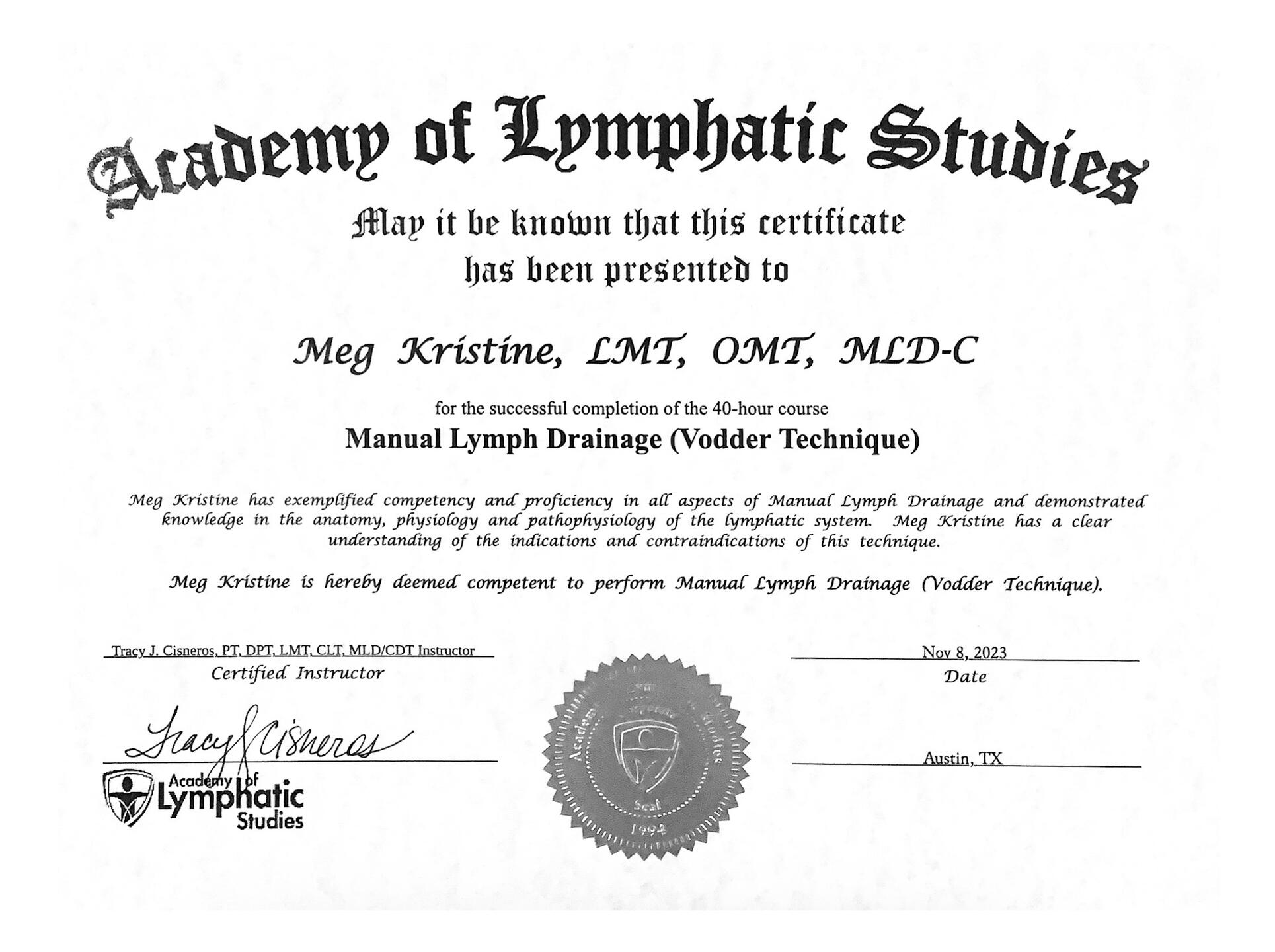
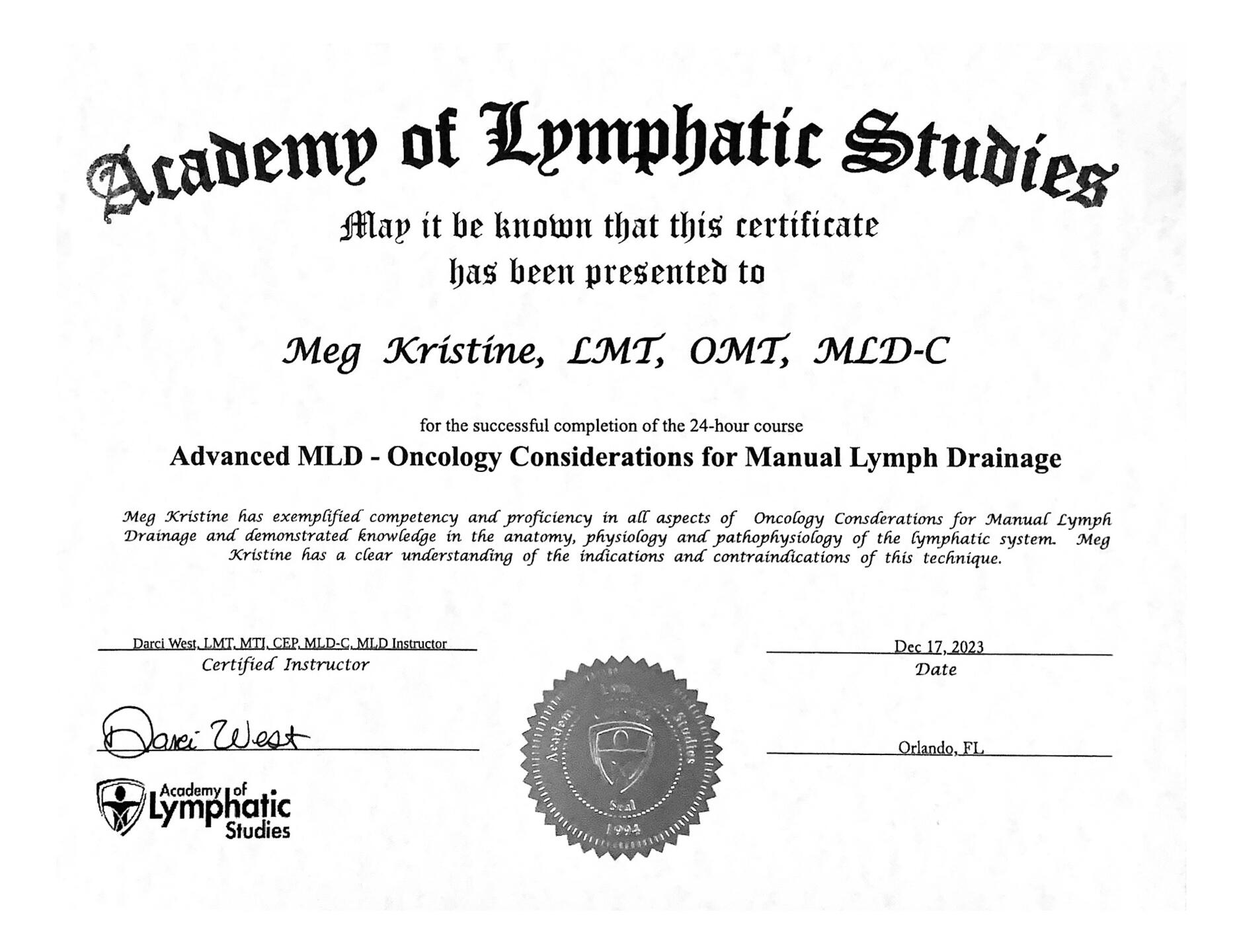
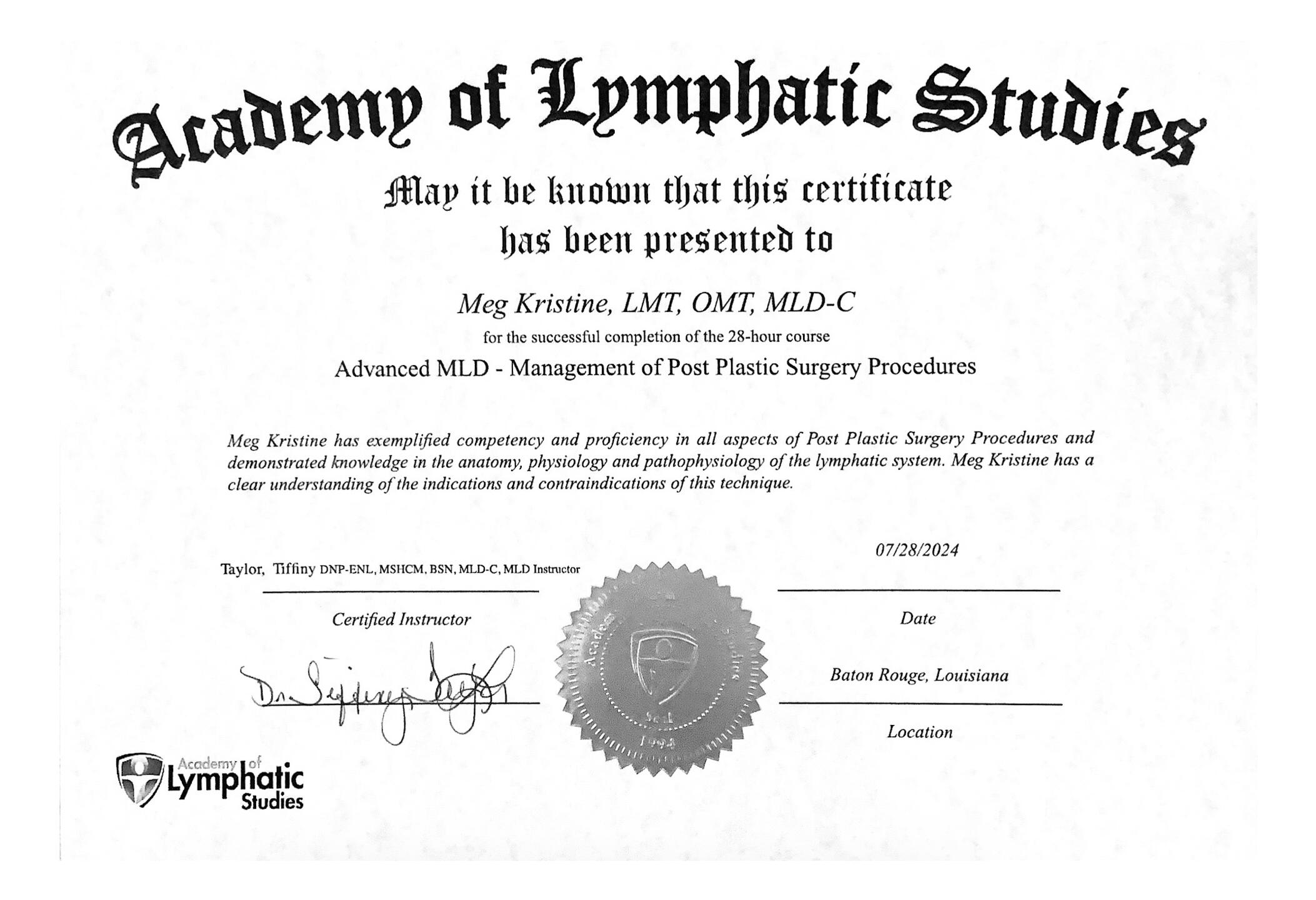
LMT, OMT, MMP, CIMI, CPMT, MLD-C (abbreviations below)My name is Meg Kristine & I've been a Licensed Massage Therapist since 2012. I’m Certified in Massage Therapy for Wellness, Autism, Oncology, Palliative, & Hospice (for both Adult and Pediatric Populations). I’m also Certified in Medical Massage Therapy, which is interwoven into my regular Massage Practice. I’m a Registered Member and Preferred Practitioner of The Society for Oncology Massage (www.S4OM.org). I’m twice certified in Manual Lymphatic Drainage (Vodder Technique), with Advanced Secondary Training & Certifications in both Oncology Considerations & Post-Plastic Surgery Procedures.I'm not only passionate about the work that I do, I’m honored to be able to do it. My hope is that with the above skillsets, I’m able to best meet each client where they are, & assist them on their individual path to healing.-LMT: Licensed Massage Therapist
-OMT: Oncology Massage Therapist
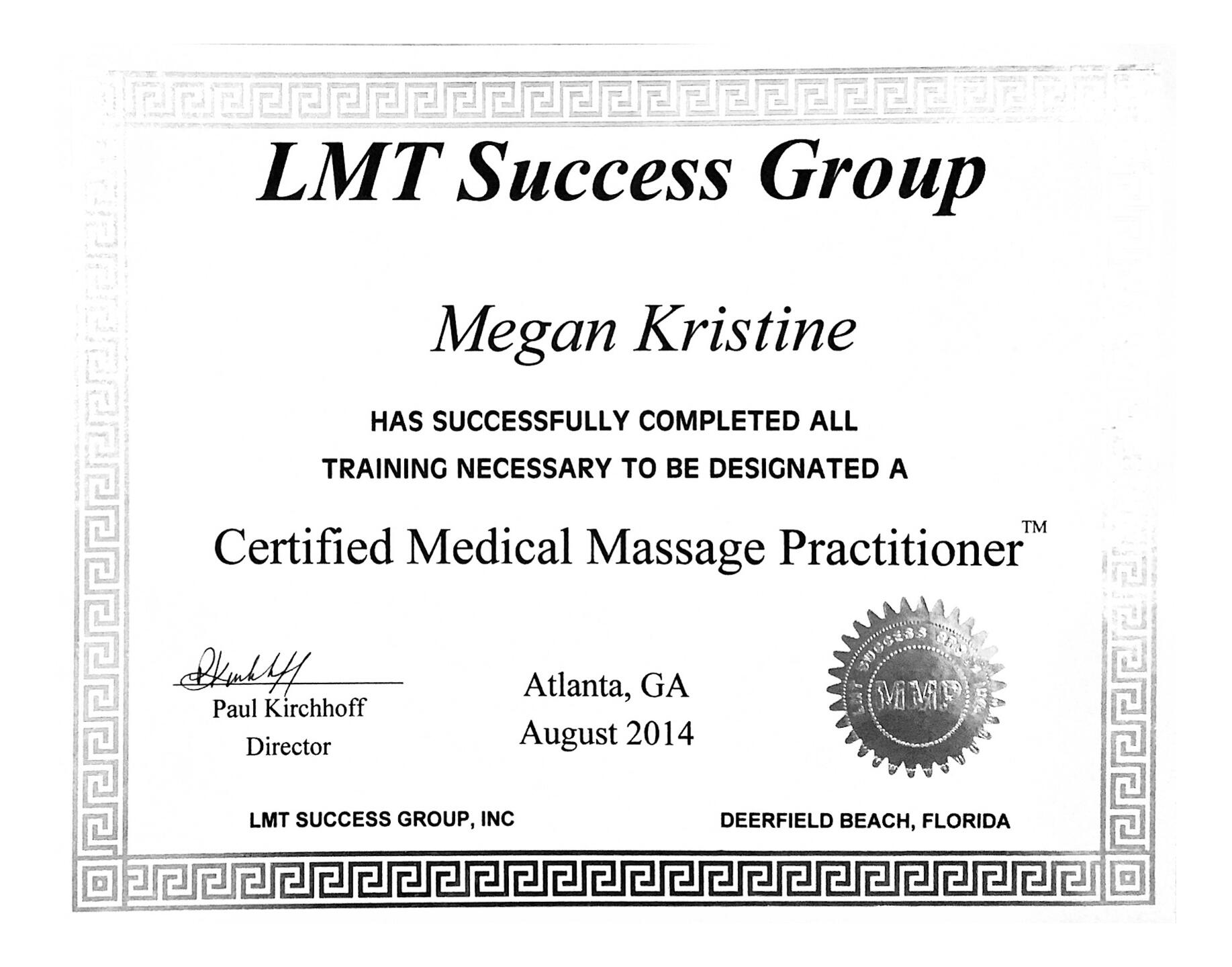
-MMP: Medical Massage Practitioner
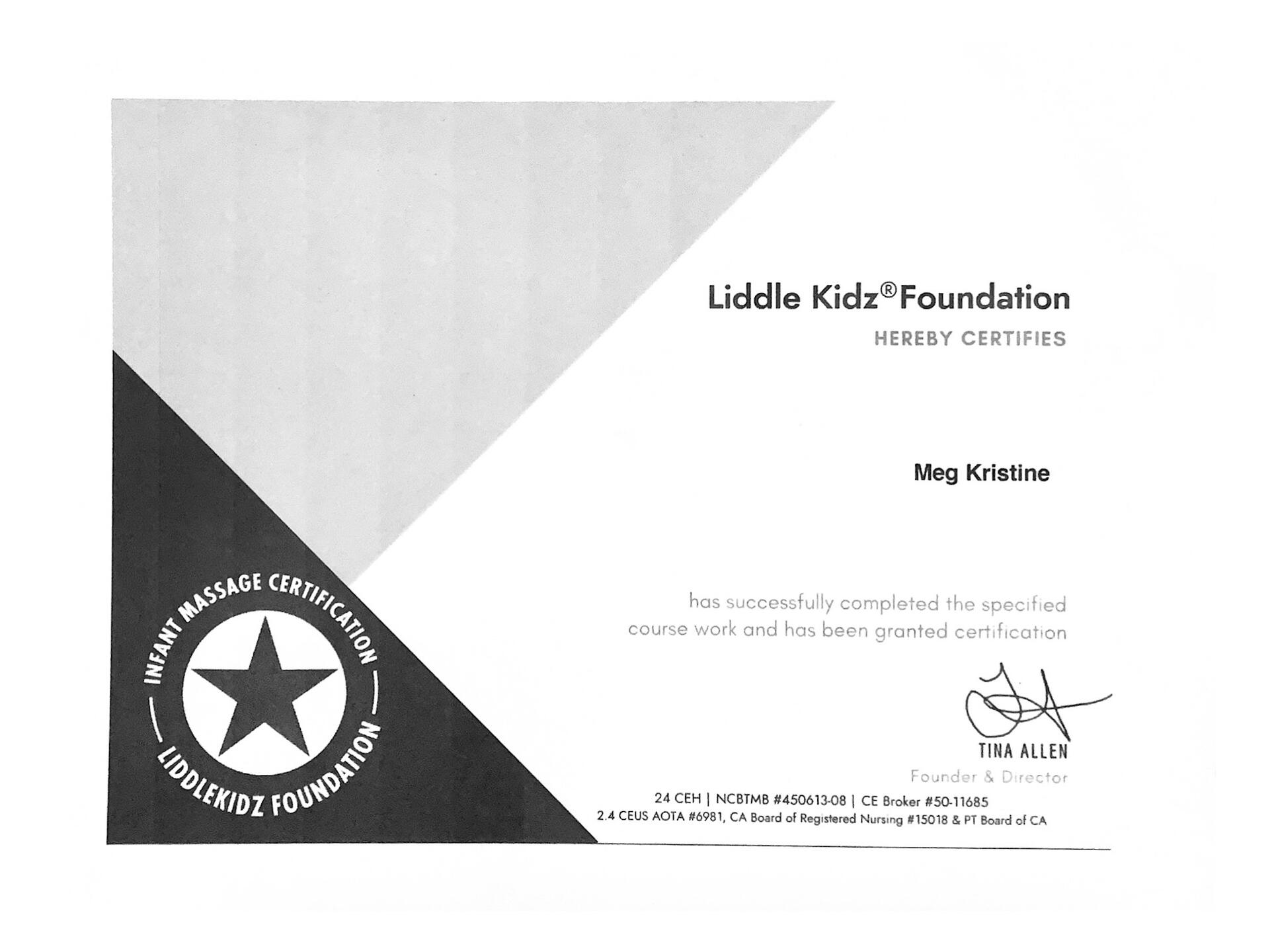
-CIMI: Certified Infant Massage Instructor
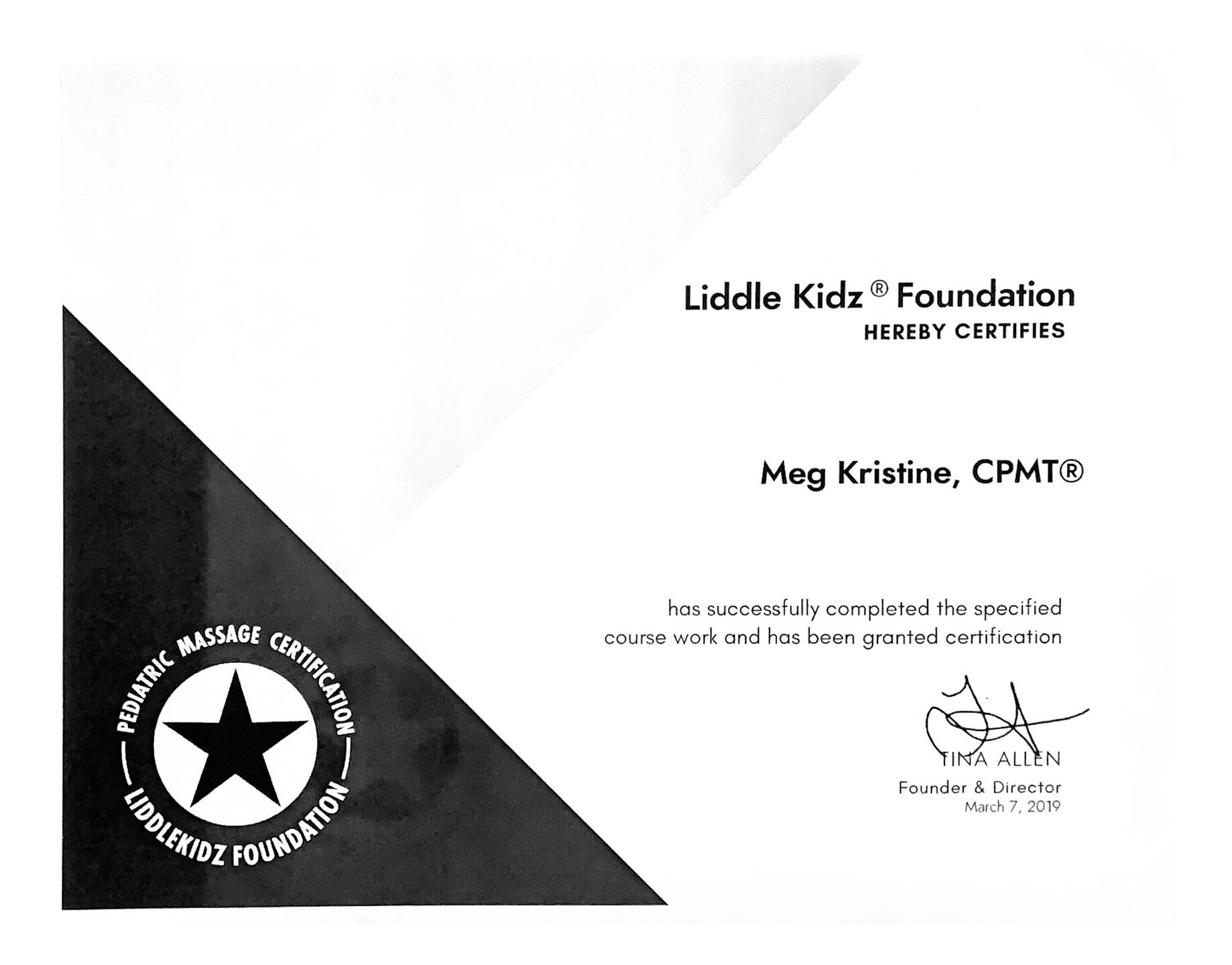
-CPMT: Certified Pediatric Masage Therapist
-MLD-C: Manual Lymph Drainage Certified
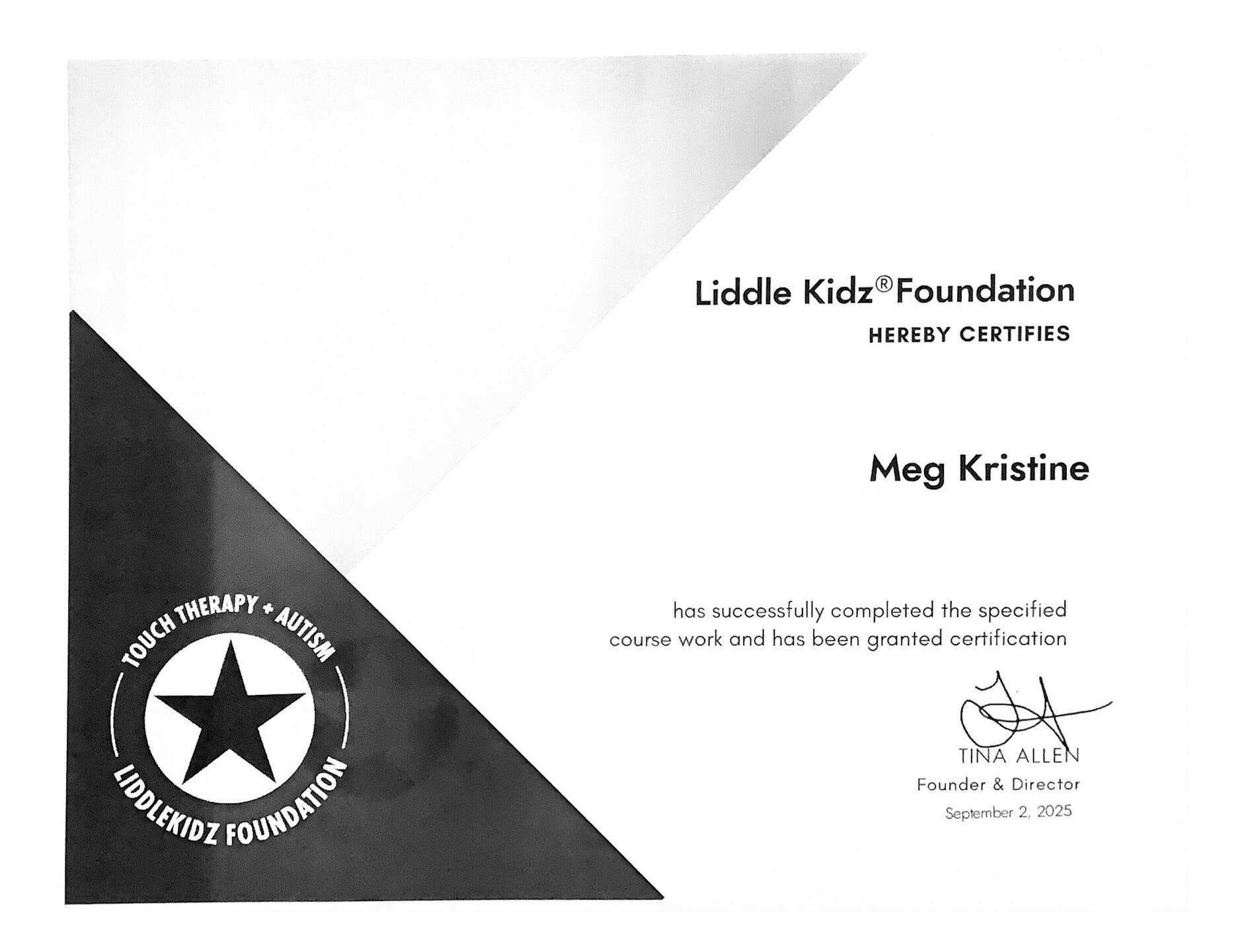
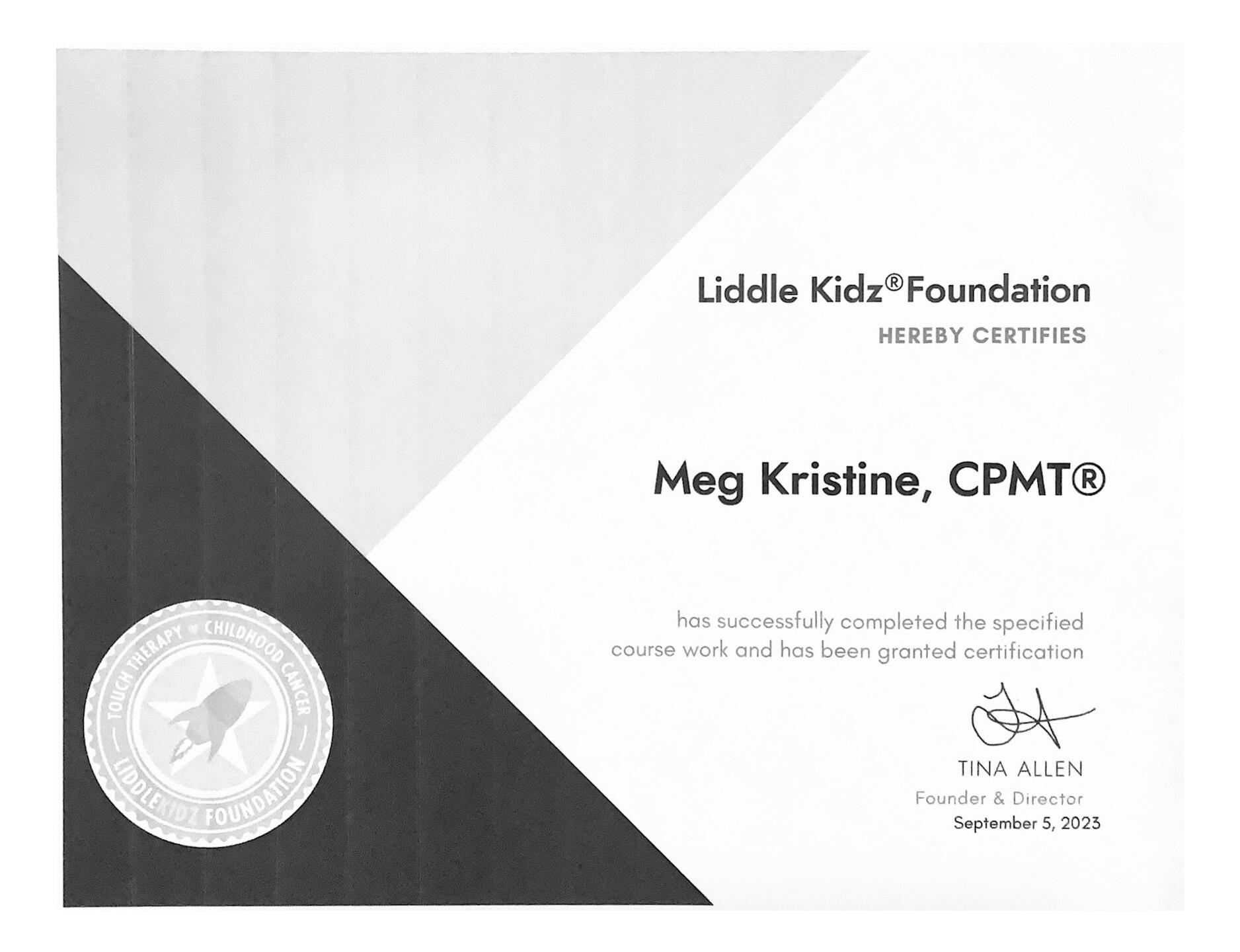
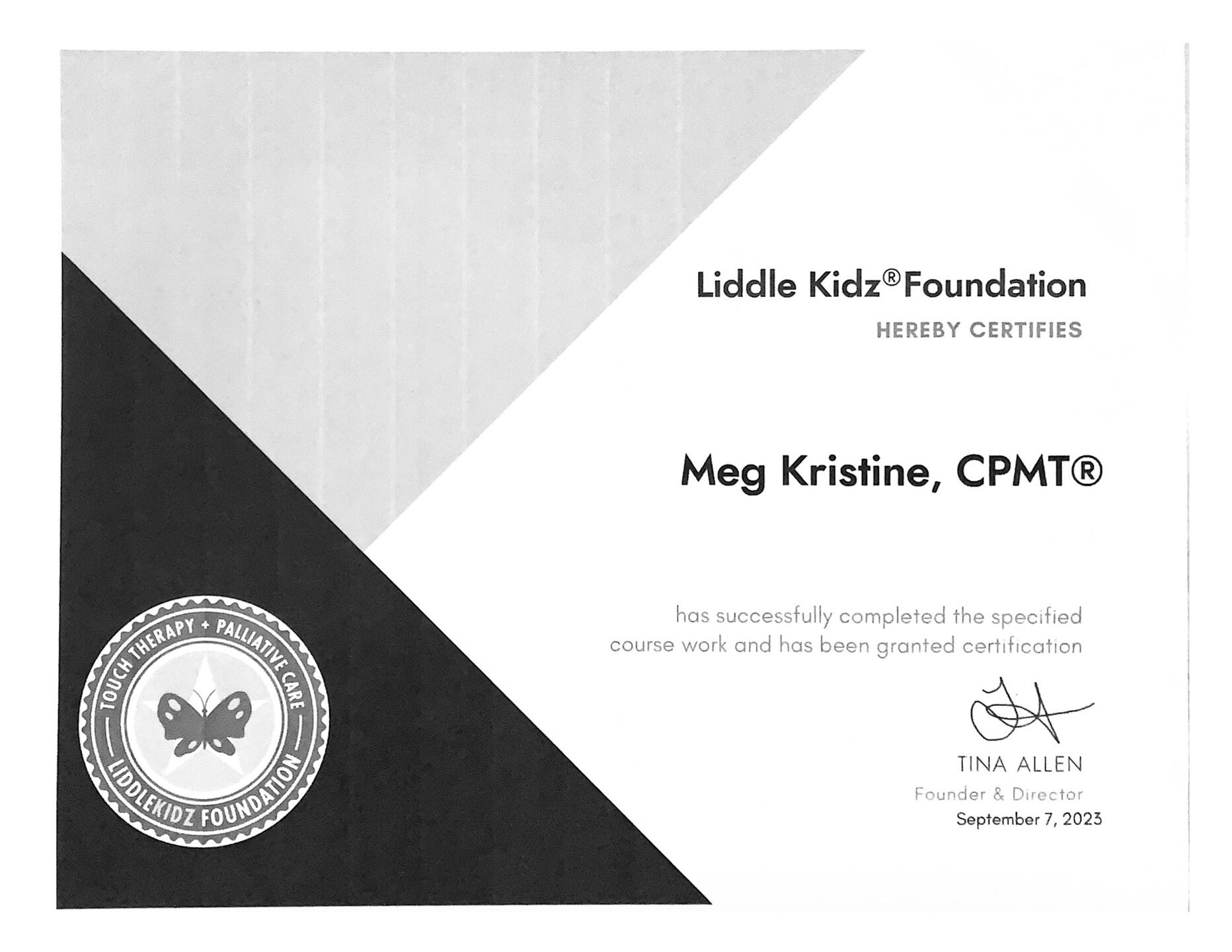
Certifications
Meg Kristine, LMT, OMT, MMP, CIMI, CPMT, MLD-C
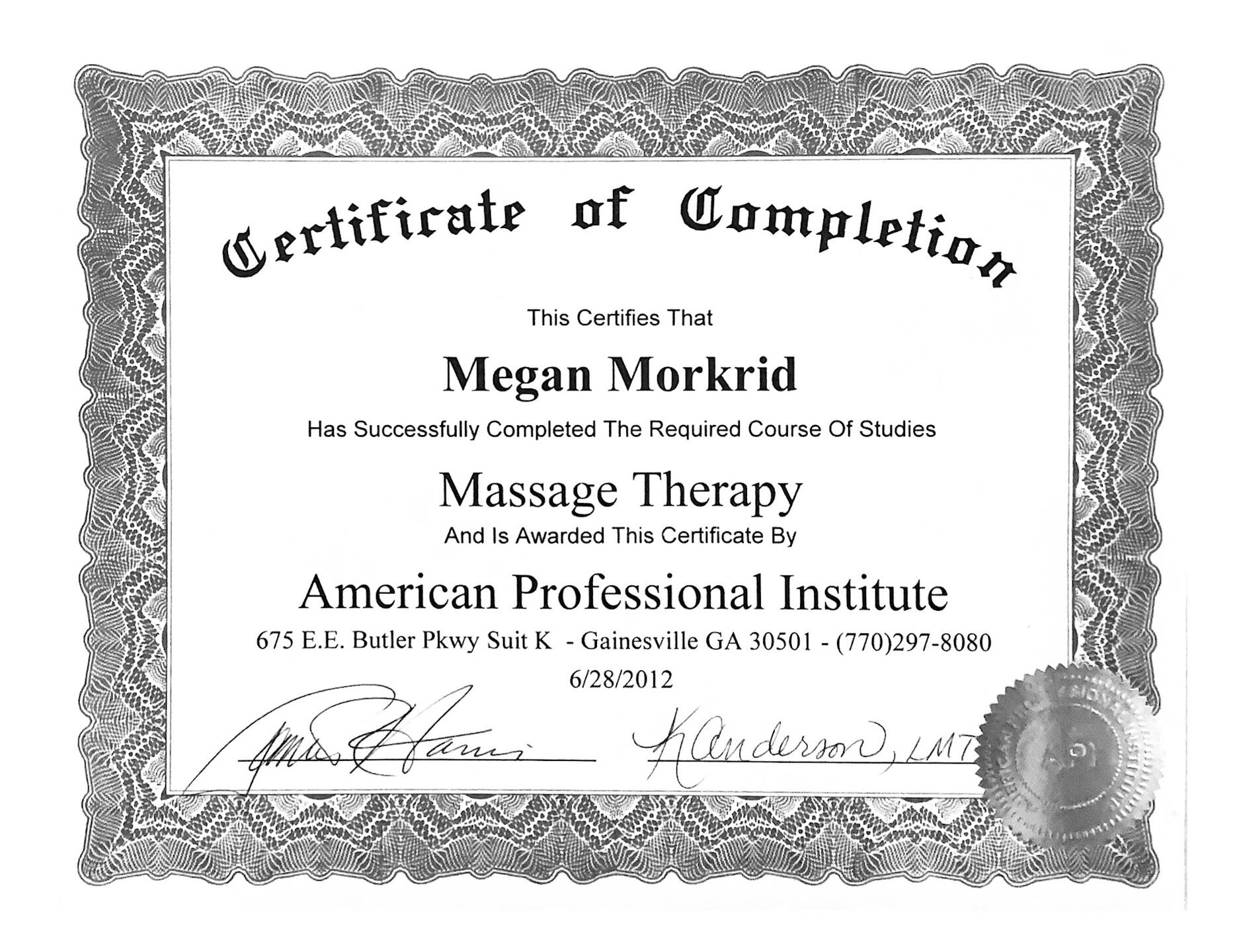
LA License: LA #8860Massage & Touch Therapy Certificates:

Massage Therapy

Medical Massage Therapy

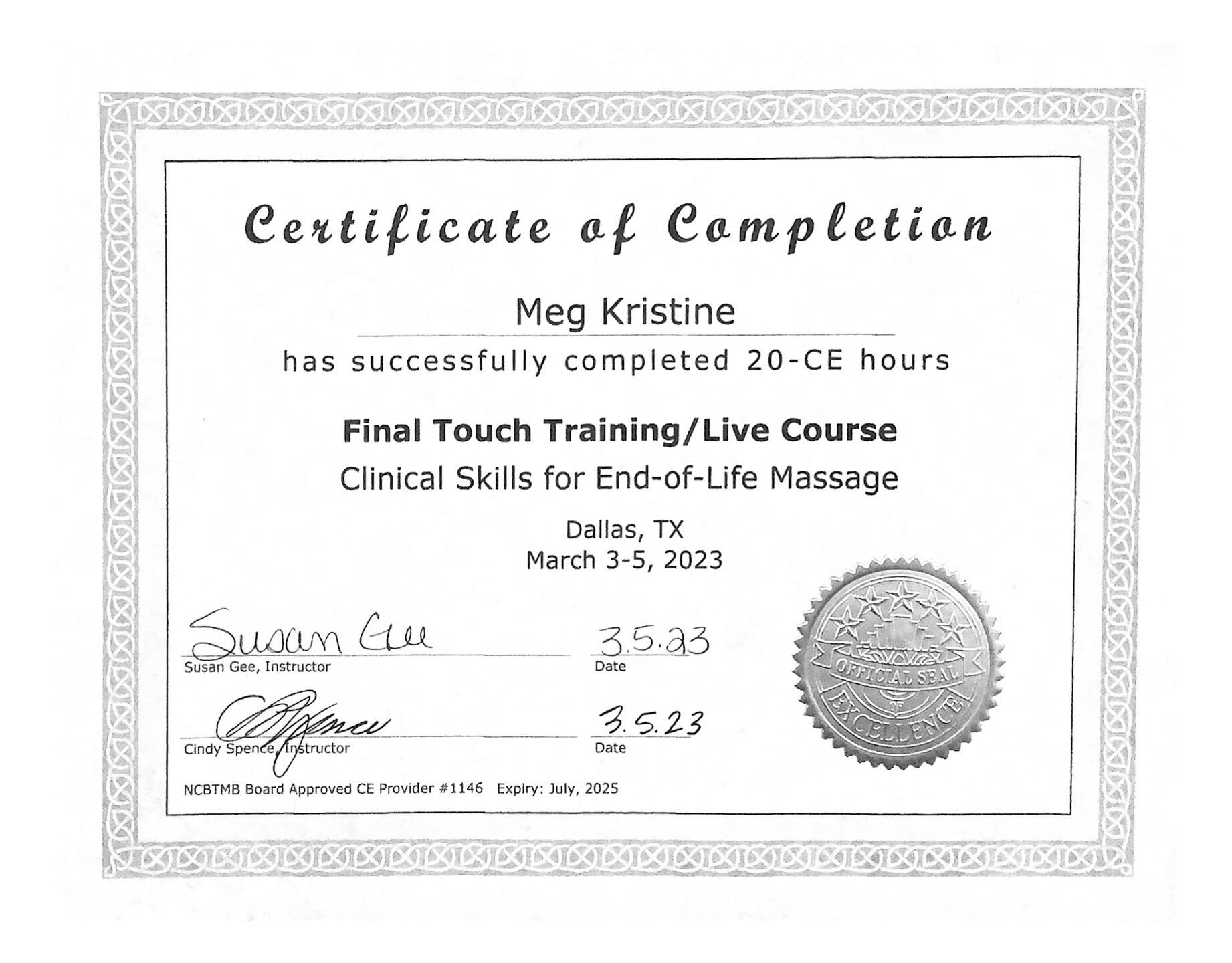
Palliative/Hospice Massage & Touch Therapy

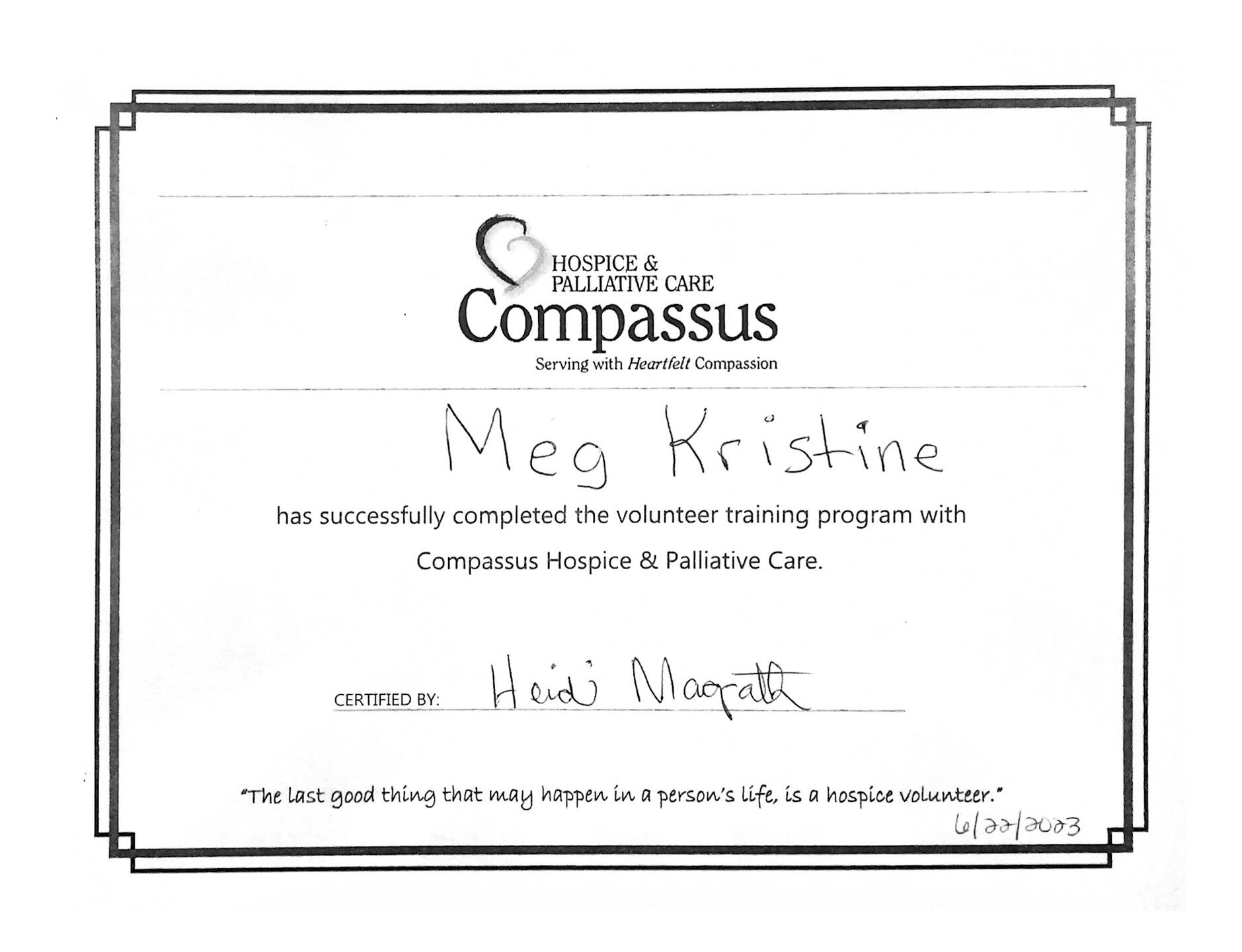
Palliative/Hospice Volunteer Work

Infant Massage & Touch Therapy Instructor

Pediatric Massage & Touch Therapy

Pediatric Autism Massage & Touch Therapy

Pediatric Oncology Massage & Touch Therapy

Pediatric Palliative/Hospice Massage & Touch Therapy

MLD- Manual Lymphatic Drainage (Vodder Technique)

Advanced MLD for Oncology Considerations

Advanced MLD for Post Plastic Surgery Procedures
Contact Me
Message Successfully Sent.
Thank you!